

Geocoding and Sales Tax API: Why Address Accuracy Matters
When people compare sales tax API services, they often focus on the tax rates.
But before a sales tax API can determine a tax rate, it must first answer a more fundamental question:
Where exactly is the address located?
That may sound simple, but the accuracy of an address lookup can directly affect the tax jurisdictions and tax rates returned by the system.
In many cases, the challenge isn’t calculating sales tax—it is determining the precise location where the tax calculation should occur.
The Hidden First Step in Sales Tax Calculation
Most people think of sales tax determination like this:
Address → Tax Jurisdictions → Tax Rate
In reality, there is an important step in between:
Address → Geocoding → Tax Jurisdictions → Tax Rate
Geocoding is the process of converting a street address into geographic coordinates (latitude and longitude).
Those coordinates are then used to determine which tax jurisdictions apply to the address.
If the location is incorrect, the tax result may also be incorrect.
Why Location Accuracy Matters
Many tax jurisdictions are defined by geographic boundaries.
These boundaries may include:
- states
- counties
- cities
- special tax districts
A sales tax API typically determines which jurisdictions apply by evaluating the geographic location of an address against those boundaries.
In many cases, even a small difference in location can affect the result.
The closer an address is to a jurisdiction boundary, the more important geocoding accuracy becomes.
A Real-World Example from Arizona
Consider the Queen Creek Special District in Arizona.
This district covers a relatively small area near the intersection of Rittenhouse Road and Ocotillo Road.
Addresses located within the district are subject to an additional:
Queen Creek City Special District Retail Tax: 2.25%
Addresses outside the district do not receive this additional tax.
For example:
21292 E Ocotillo Rd, Queen Creek, AZ 85142
falls within the special district boundary and receives the additional 2.25% district tax.
As a result, the total sales tax rate for the address is:
10.8%
The district boundary is shown below in green.
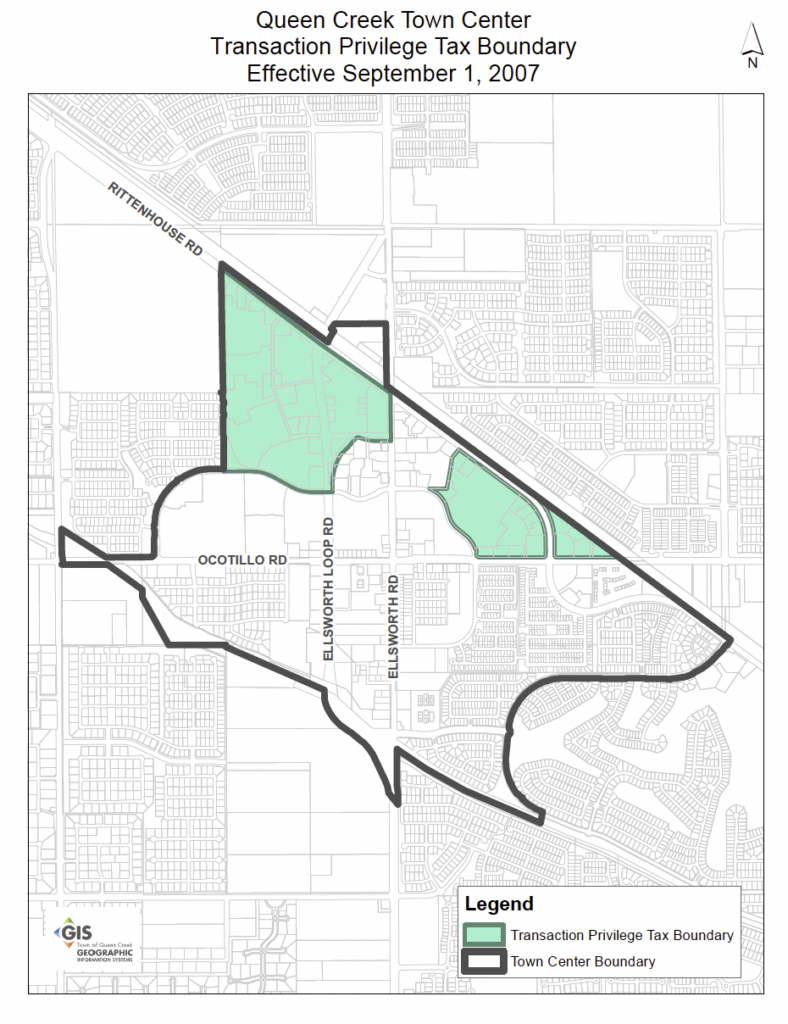
Queen Creek City Special District boundary. Addresses located within the district receive an additional 2.25% special district retail tax.
How Address Accuracy Affects Sales Tax API Results
In this example, the special district boundary itself is relatively small.
An address placed on the wrong side of the boundary could miss the additional 2.25% district tax entirely.
Imagine two systems evaluating the same address.
If one system places the address correctly within the district boundary, the special district tax is applied.
If another system places the address outside the boundary, the district tax is missed.
The difference is not the tax calculation itself.
The difference is the location used to determine which jurisdictions apply.
This is one reason geocoding accuracy can have a direct impact on sales tax accuracy.
Not All Geocoding Results Are Equal
Different systems may determine slightly different locations for the same address.
Factors may include:
- address quality
- available reference data
- rooftop versus interpolated locations
- new construction
- rural addressing
- boundary proximity
For most addresses, these differences may not affect the final tax result.
However, when an address is located near a tax jurisdiction boundary, even small location differences can matter.
Geocoding Data Sources Matter for Sales Tax Accuracy
Not all geocoding systems determine address locations the same way.
Many organizations rely on third-party geocoding services to convert addresses into coordinates.
USgeocoder takes a different approach.
In addition to tax jurisdiction data, we maintain our own address geocoding system using a combination of U.S. Census data and parcel-level information to determine address locations.
This allows us to control both the geocoding process and the jurisdiction lookup process within the same platform.
While no geocoding system is perfect, accurate address placement becomes increasingly important when tax jurisdictions are defined by small or complex geographic boundaries.
Why Sales Tax API Can Return Different Results
When organizations compare sales tax APIs, they sometimes assume differences are caused by tax rates or jurisdiction data.
In reality, the first difference may occur much earlier in the process.
If two systems place the same address in different geographic locations, they may evaluate different jurisdiction boundaries and ultimately return different tax results.
That means sales tax accuracy depends on more than tax data alone.
It also depends on accurately locating the address.
A Practical Approach for Sales Tax API
Accurate sales tax determination requires both:
- accurate jurisdiction boundary data
- accurate address geocoding
Both components work together.
Even the best tax jurisdiction data cannot produce the correct result if the address is placed in the wrong location.
Likewise, accurate coordinates alone are not enough without reliable jurisdiction boundaries.
Key Takeaway
Sales tax APIs do more than calculate tax rates.
They must first determine where an address is located.
That location drives every jurisdiction lookup that follows.
The next time you compare sales tax APIs, remember that tax accuracy starts with address accuracy.
Because before a system can determine the correct tax rate, it must first determine the correct location.
Related Resources
- How Sales Tax APIs Determine Tax Jurisdictions and Rates by Address
- The Hidden Challenge of Sales Tax Boundary Data
- Shapefiles for Sales Tax Jurisdictions
Final Thoughts
Most sales tax systems appear simple from the outside:
Address in → Tax rate out.
But behind that seemingly simple workflow is a geocoding process that determines where an address is located before any tax jurisdictions can be evaluated.
And when an address sits near a tax jurisdiction boundary, even small differences in location can affect the final result.
That’s why tax accuracy starts with address accuracy.
 2026 Sales Tax by State – Nebraska