

Sales Tax API vs. Tax Rate Files: Which Is Right for Your Business?
When integrating sales tax data into an ERP, POS, or commerce platform, one important decision is how your application will access that data. Should it call an Sales Tax API when tax information is needed, maintain sales tax rate files locally, or use both?
The right approach depends on transaction volume, system architecture, data maintenance requirements, and geographic accuracy. Understanding these differences can help you choose an approach that fits your application.
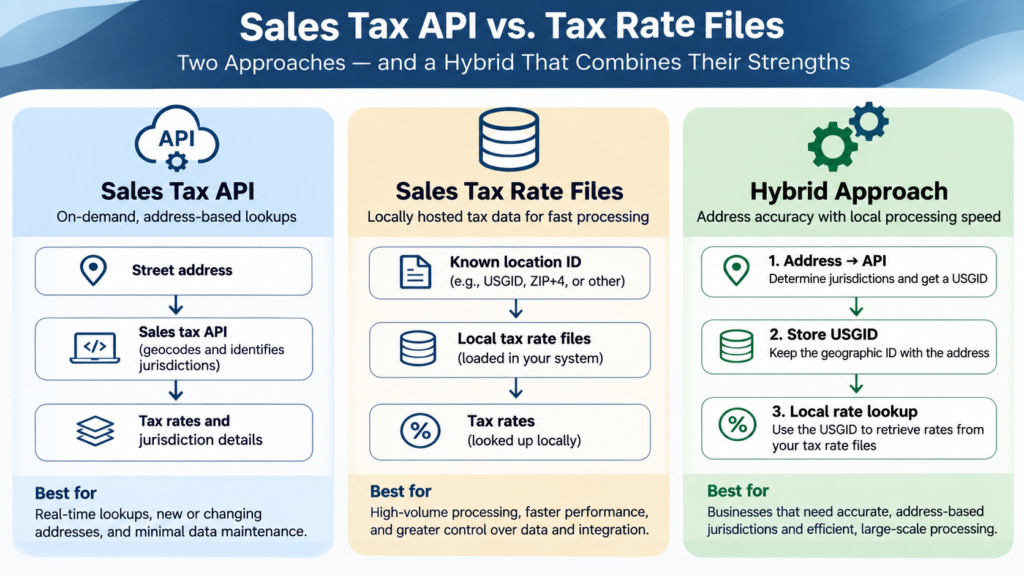
Sales Tax APIs: Lookups When You Need Them
An address-based sales tax API accepts a street address, identifies its geographic taxing jurisdictions, and returns the applicable rates and jurisdiction details.
It’s useful for e-commerce checkouts, ERP applications, and systems that regularly encounter new shipping addresses.
The API provider maintains the underlying geographic and rate data, reducing the customer’s maintenance work. The trade-off is that each lookup involves an external request, with potential network latency, usage charges, and request limits.
For many applications, these considerations are manageable. For systems processing millions of transactions, however, the cost and performance of repeated requests may deserve closer examination.
Sales Tax Rate Files: Process Transactions Locally
Sales tax rate files let businesses load tax data into their own databases. Depending on the provider, rates may be organized by ZIP+4, jurisdiction codes, or geographic identifiers.
Imagine a distributor generating 500,000 invoices overnight. If its ERP system already has the correct geographic identifier for each shipping address, it can retrieve the matching rates locally rather than call an API for every invoice.
Local processing offers speed, control, and flexibility. But the business must load updated files, handle effective dates, and maintain accurate address-to-jurisdiction assignments.
A fast lookup is useful only if it points to the correct taxing area and the rate applicable to the transaction date.
Geographic Accuracy: ZIP+4 vs. Street Address
ZIP+4 codes were designed for mail delivery, not tax administration. A ZIP+4 area can cross a taxing district boundary, so postal information alone may not always identify the correct jurisdiction combination.
For example, two nearby Texas addresses can share a city and county but differ in whether a special purpose taxing district applies.
Address-based geographic determination takes a different approach: geocode the physical location, then identify the state, county, municipality, and special districts containing that point.
This is separate from how rates are delivered. An API is not automatically more accurate than a tax rate file. Accuracy depends on the geographic data and the method used to associate an address with its taxing jurisdictions.
The Hybrid Approach: Address Accuracy and Local Speed
Businesses don’t necessarily have to choose between accurate address identification and high-volume local processing.
In a hybrid system, an address-based API first determines the applicable jurisdiction combination and returns a geographic identifier. The ERP system stores that identifier with the shipping address. Subsequent transactions use it to retrieve rates from locally hosted files.
This separates two jobs: determining where an address falls and retrieving the rates for that location.
An unchanged shipping address doesn’t necessarily need a new API call for every transaction. However, its jurisdiction assignment must be revalidated when relevant boundaries or address information change.
Example: Aurora, Colorado
Consider 24495 E 35th Drive, Aurora, CO 80019.
A USgeocoder example lookup returns USGID CO00003, identifying the applicable jurisdiction combination, with the following sales tax breakdown:
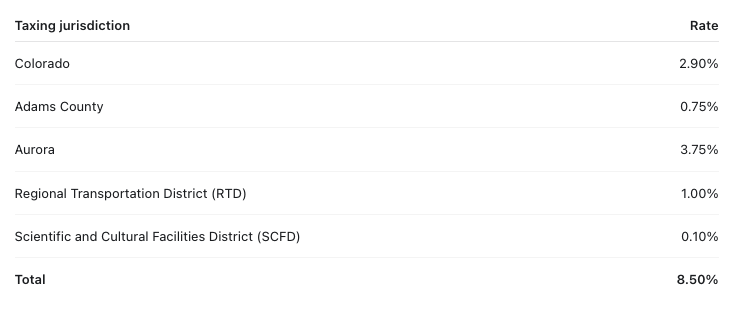
The example lookup reports an effective date of January 1, 2023. These figures illustrate that rate record and should not be assumed to be current.
An ERP system could store CO00003 with the address and use it to retrieve rates from a local file.
If rates change but the jurisdiction combination remains the same, the USGID stays unchanged. The system must still select the rate record applicable to the transaction date.
For example, a December transaction and a January transaction may require different rates even when both share the same USGID.
A geographic boundary change is different. If the address enters or leaves a taxing district, it may require a different USGID. Updating the rate file alone won’t correct an outdated address assignment.
See our Colorado bulk address lookup example for additional details.
How USgeocoder Supports Different Architectures
USgeocoder provides geographic tax intelligence through address-based APIs, enterprise tax rate files, and batch address processing.
Its enterprise files contain jurisdiction combinations, tax rates, and persistent geographic identifiers called USGIDs. Monthly comparison reports identify added, removed, and updated records to help customers maintain their local data.
These services support API-only, file-based, and hybrid implementations, depending on the customer’s requirements.
USgeocoder provides geographic jurisdiction and rate information. Businesses remain responsible for applying the appropriate tax calculation and product taxability rules.
Which Approach Fits Your Business?
An API is often the simplest choice for on-demand address lookups. Local files can be effective for high-volume processing within existing systems. A hybrid architecture can combine address-based jurisdiction accuracy with efficient local rate retrieval.
The best solution depends on your application—not just how the data is delivered.
To discuss sales tax data integration for your ERP or commerce platform, contact USgeocoder at 888-938-6732, start a Live Chat on USgeocoder.com, or visit our Contact Us page.
 2026 Colorado Sales Tax Rate Changes